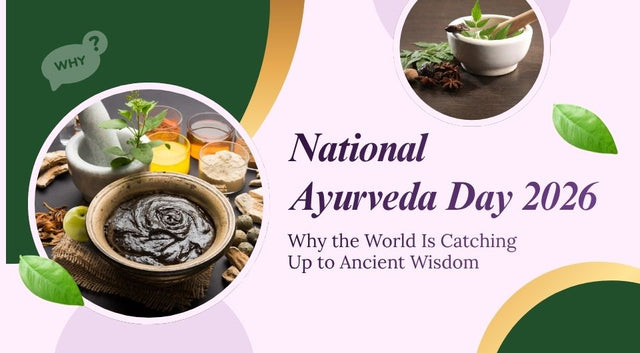
National Ayurveda Day is one such quiet yet significant day on India's health calendar that passes by every year. It has a bit more weight in 2026, as it is the 11th celebration of this observance and the theme is particularly apt for the direction global health is moving in – "Ayurveda for a Healthier Tomorrow. In the past, traditional practice was considered a niche practice, but it now occupies a new space where much of the world is having serious conversations about prevention, sustainability and overall wellbeing.
In this article, we’ll delve into the significance of National Ayurveda Day 2026, its timing, and how the rest of the world is embracing concepts that Ayurveda has championed for millennia.
When and Why Ayurveda Day Falls on September 23
National Ayurveda Day 2026 is celebrated on 23 September, and the theme for the year is 'Integrating Ayurveda & Allopathy'. The theme of the year 2026 is being celebrated at the main event in Nagpur. This date is not a random date. Prior to 2016, Ayurveda Day was celebrated on the day of Dhanteras, which is considered to be the day of the origin of Ayurveda, and is also believed to be the birthday of the original propagator of Ayurveda, Dhanvantari, a divine physician. Due to the fact that Dhanteras falls on the lunar calendar and changes each year, the Government of India has fixed the date for the observance of the Dhanteras to September 23, 2025, with a gazette notification in 2025.
September 23 is also significant because it falls on the day of the fall equinox, when the length of the day and night are roughly equal on Earth. This balance between day and night is in keeping with one of the principles of Ayurveda, to strive for balance between mind, body, and spirit, and the date is therefore a very appropriate and deliberate one, as opposed to a mere administrative decision.

This Year's Theme: Ayurveda for a Healthier Tomorrow
The theme of Ayurveda Day 2026, "Ayurveda for a Healthier Tomorrow," is not just a nostalgic celebration of the past, but an optimistic look toward the future. This year's celebration of Ayurveda doesn't stop at celebrating it as traditional medicine, but makes it a very much contemporary vehicle for solving current and future health issues.
The campaign for 2026 revolves around three focus areas namely Integrative Healthcare for improved health outcomes, Evidence, Research and Innovation in Ayurveda and Ayurveda for community wellbeing and sustainable living. These focus areas point to a strong direction in which Ayurveda will be transitioning from a fringe alternative form of medicine to more scientifically valid and integrated health care systems.
Why the World Is Increasingly Turning to Ayurvedic Principles
The philosophy of Ayurveda is strongly linked with a few major paradigm changes in the global healthcare and wellness world today, all of which are based on the principle of prevention, individual constitution (prakriti) and Ayurvedic life style based balance:
-
The emphasis on preventive healthcare: Today, healthcare systems around the world are increasingly focusing on preventing diseases instead of waiting to treat them, and Ayurveda has been doing this in its traditional way for thousands of years by emphasizing on diet, daily routine and way of life to prevent diseases.
-
Growing interest in personalized wellness: Ayurveda's concept of individual constitution, tailoring diet, herbs, and lifestyle recommendations to a person's specific prakriti, mirrors the direction personalized medicine and nutrition are moving toward globally.
-
Growing interest in natural, plant-based alternatives: With increasing awareness of the dangers of overmedication and synthetic additives, there is a growing interest in natural alternatives such as Ayurvedic herbs and formulations, provided they are well-sourced and quality-tested.
-
Living in harmony with nature, seasons, and environment: Ayurveda's holistic approach to living in harmony with nature, seasons and environment is in sync with the global movement towards sustainable, eco-conscious living.
-
Integrative healthcare models: This year's Ayurveda Day theme is integrative healthcare models, which is a different way of looking at ayurveda as a complementary medicine or system of healthcare along with conventional systems and not opposing them.
This change is driven by the use of evidence and research.
The emergence of scientific research on the herbal preparations and therapies of Ayurveda is one of the most important factors contributing to the credibility of this system in the worldwide arena. The scientific research into the effects of herbs on stress response, inflammation, and hormonal balance, such as for ashwagandha, turmeric, and shatavari, adds a contemporary layer to the traditional knowledge.Herbs like ashwagandha and turmeric have seen their benefits on stress response, inflammation, and hormonal balance studied and documented and have added a scientific dimension to the knowledge gained through centuries of observation.
It is this reason that the three focus areas for this year are: "evidence, research, and innovation. The more advanced studies confirm the effectiveness of certain Ayurvedic mixtures and techniques, the more the system is being accepted as a legitimate complementary healthcare alternative and rejects the Folk belief that Ayurvedic medicine is a mere superstition.

What This Means for Everyday Ayurvedic Practitioners
For all of you already subscribing to an Ayurveda lifestyle, National Ayurveda Day is a time of celebration that you already know it is right for you and a reminder to keep following the true Ayurvedic principles, be mindful of your dosha, eat seasonally, maintain a proper daily routine, and rely on herbal support that is of high quality, not the diluted, trendy version they are peddling.
With the acceptance and recognition of Ayurveda becoming a global phenomenon, it is important to make sure that the practice practiced by people is as deep as it is in its traditional form and not as shallow as a simple trend in the wellness industry, by choosing the right formulation and sourcing the products from the right brands, which make it sure that there is a proper testing of the ingredients and it is an authentic product.
Looking Ahead
With the National Ayurveda Day 2026 taking place in Nagpur and throughout the country, one thing is becoming evident: While Ayurveda is firmly established as India's cultural legacy to be preserved, it's also well on its way to becoming a model of healthcare relevant to the rest of the world, and in increasing numbers, to being adopted by people there as well. From integrative hospital models to targeted studies of specific herbal compounds to just a change in the way people live their daily lives, the philosophies of Ayurveda as they have been passed down for millennia are now influencing the ways people are thinking about a healthier future.
Conclusion
In today's time, when the entire world appears to be following the footprints of the Ayurvedic principles that have been practiced for thousands of years, preventive healthcare, customization, natural remedies, and a holistic approach to life and sustainability are emerging as the need of the hour. The year's theme is "Ayurveda for a Healthier Tomorrow," as you might expect, the answer is not to opt for ancient wisdom versus modern healthcare, but to find a way to combine them in a thoughtful manner. The essence of Varah's work is to stay true to the principles and practice of Ayurveda as a quality-centric system, which is the most valuable way to be a part of that bigger change.
Frequently Asked Questions
Q: In what way did the date of National Ayurveda Day get changed?
A: It became a fixed date, September 23, by a government gazette notification in 2025 to make it more visible to the world and consistent from year to year, rather than having a lunar calendar-based date.
Q: September 23 is the actual date. What is its significance?
A: It falls during the autumnal equinox, representing the harmony between day and night, reflecting the principle of balance in Ayurveda, which encompasses harmony among mind, body, and spirit.
Q: What is this year's Ayurveda Day theme?
A: "Ayurveda for a Healthier Tomorrow" will have 3 thrust areas: Integrative Healthcare, Evidence and Research in Ayurveda, Community wellbeing and Sustainable living.
Q: Is Ayurveda meant to replace conventional medicine?
A: No, the current perception on framing, including this year's official theme, equates Ayurveda as a complementary, integrative system with conventional medicine and not as a replacement for conventional medicine.